

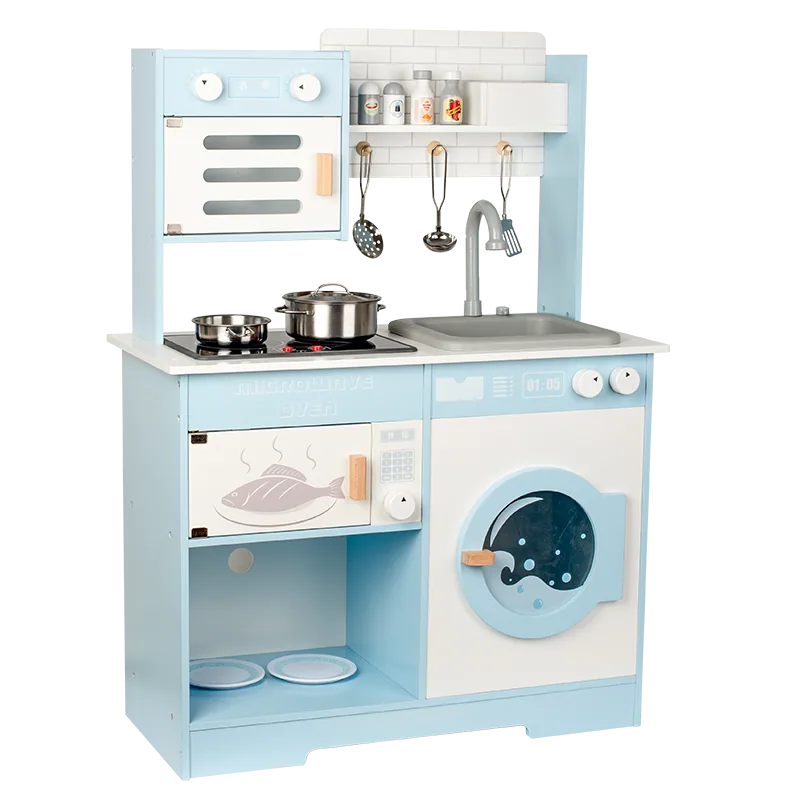


Wooden play kitchens at wholesale: the three decisions that move your margin
A play kitchen is a piece of furniture that happens to be a toy. That changes the sourcing conversation: the specification is bigger, the carton is bigger, and the things that go wrong are different from the ones that go wrong on a puzzle. Almost all of the commercial risk sits in three decisions.
1. Flat pack or assembled
Flat-packed kitchens cut container cost dramatically because the carton holds more usable volume. The trade-off is assembly time for the customer and a higher risk of returns if the instructions are unclear or a fitting is missing. Partly assembled and fully assembled formats suit different retail channels, and the choice often decides whether the item can be sold online at all.
2. Carton cube and freight
Play kitchens are volume, not weight, so you pay for air. Carton dimensions, how the components nest, and how many units fit a pallet will change your landed cost more than a small movement in the factory price. It is worth fixing the carton at the same time as the product, because a kitchen designed without the carton in mind usually ends up with a packaging solution that wastes space.
3. Components and spare parts
Hobs, taps, knobs, hinges, door catches and fabric or felt accessories are the parts that fail, go missing or get damaged in transit. Buyers who plan for a small quantity of spare fittings in the carton, or a documented spares procedure, spend less time on after-sales than buyers who do not. This is also where a single-supplier programme pays off: the fittings stay the same between shipments.
Safety and labelling
Play kitchens need CE marking and EN71 testing in the EU, and ASTM F963 compliance with third-party testing and a Children's Product Certificate in the United States. The recurring questions are stability, entrapment around doors and hinges, sharp edges on assembled panels, small fittings, and paint migration on decorated surfaces. We produce to both standards and supply the reports covering the items you order; the certificates we can publish are listed on the toy safety standards page.
Seasonality
Play kitchens are a gift item, so demand concentrates hard in the run-up to the gift season, and the production window is longer than for small toys because of the component count and the packaging. A typical production cycle is around 30 days after order confirmation, with printed packaging needed earlier still.
Ordering
In-stock items start at 50 pieces per item. Samples are charged per item; in-stock items are normally dispatched within 48 hours and custom sampling takes about 10 days, with the sample fee deducted from the bulk order once the order for that item reaches 1,000 pieces. Send your specification and we will quote the product and the carton together.
Wooden play kitchen MOQ, samples and lead times
A play kitchen is a piece of furniture that happens to be a toy. The sourcing conversation is therefore about flat pack or assembled, carton cube, components and spare parts, and how early the printed packaging has to be ready for the season.
| Minimum order | 50 pieces per item for in-stock wooden toys. OEM, ODM and private-label items are quoted per product, because the minimum depends on how much of the item is customised. |
|---|---|
| Samples | Items already in the range are usually dispatched within 48 hours. Custom sampling takes about 10 days. |
| Sample credit | The sample fee is deducted from the bulk order once the order for that item reaches 1,000 pieces. |
| Production lead time | Around 30 days after order confirmation, subject to order complexity, material and quantity. |
| Payment | 30 percent T/T deposit in advance with the balance before shipment; final terms are confirmed with your order. |
| Documents | EN71 (EU) and ASTM F963 (US) test reports covering the items you order, CPSIA and the Children's Product Certificate for the United States. |
| Mixed orders | Several categories can be combined into one shipment, so a container can be built from more than one product line. |
How to compare wooden play kitchen suppliers
Six questions separate a supplier who can run this line year after year from one who can only quote it once.
- Does the factory make it, or buy it in? Ask which plant produces the item and whether the woodworking and the painting happen in the same place. Ours are made in our own 6,000 m2 plant in Yunhe, Zhejiang.
- Are the test reports for this exact item? A report has to name the model you are buying, not a similar one from the same family. We supply the reports that cover the items on your order.
- What happens on the repeat order? Finish, colour and dimensions have to stay put between the first order and the fourth. Automatic woodworking and painting lines are what make that repeatable.
- Who decides the carton? Carton dimensions and packing format move the landed cost more than a small change in unit price, so they belong in the quotation, not in the shipping discussion.
- What is the position on spare parts? Missing or damaged components are the most common after-sales claim on wooden toys; ask how replacements are handled and at what point.
- Is the spare-parts list written down? On a large item, the fittings and spare parts decide whether a claim is closed with a replacement bag or with a returned unit.
What usually goes wrong on wooden play kitchen orders
- Flat pack or assembled left open until the carton is quoted. This single decision drives the carton cube, the freight and the assembly step at the retailer.
- Components and spare parts that were never listed. A play kitchen sells on its accessories, and a missing pan is a complaint the retailer has to absorb.
- The production window missed. This category is strongly seasonal, so tooling, sampling and printed packaging have to finish before the season rather than during it.
The factory behind this wooden play kitchen range
Play kitchens are engineered and finished in the same plant as the rest of our wooden range, including the fittings and accessory sets that ship in the carton.
Everything in this range is produced in our own 6,000 m2 plant in Yunhe, Lishui, Zhejiang, by a team of 80 running automatic woodworking and painting lines. We have been making wooden toys since 2007 and export to Europe, North America and Oceania.
Products are made to EN71 (EU) and ASTM F963 (US) requirements, with CPSIA and Children's Product Certificate documentation for the United States.
Read more about wooden toy manufacturing in China, the wholesale ordering terms we work to, how OEM and ODM development runs, or send us your specification for a quotation.