

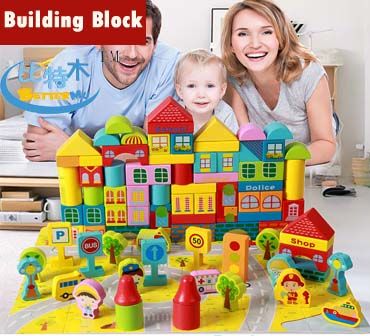
1. Check the finish, not the words on the box
"Non-toxic", "natural" and "eco" are marketing terms, not standards. What matters is whether the paint, varnish or print on the toy has been tested for migration of heavy metals under EN71-3, and whether the supplier can produce that report for the item in front of you. Two practical checks come free: smell the toy, because a strong solvent smell means the coating has not cured properly, and look at the coverage, because paint that has pooled in the corners or dried unevenly is a sign the finishing was rushed. Water-based coatings are the standard choice for wooden toys sold into the EU and the United States.
2. Check the small parts, the cords and the beads
The failure mode that worries safety authorities most is a part that comes loose and fits into a small-parts cylinder. Ask how the parts are fixed: a screw that can be backed out is weaker than a glued dowel or a fitted joint. Then look at anything that hangs or loops — pull-along cords, handles, straps, cords on a bead maze — because cord length, thickness and loop size are measured under EN71-1 for exactly this reason. Magnets and small beads deserve separate attention, since a swallowed magnet is a medical emergency rather than a choking incident.
3. Check the edges, corners and surfaces
Cut plywood, drilled holes and laser-cut shapes all produce edges. A factory that sands and seals them after cutting produces a toy that feels finished; a factory that does not produces splinters, and splinters are what generate complaints at retail level. Run a thumb along every edge of the sample, including the inside of the cut-outs and the back panel, and check that holes have been cleaned. This is also where you can tell a sample made by hand in an office from a sample made on the production line.
4. Check the age grading and the warnings
Age grading is a decision, not a description. A toy marked 3+ carries a different test list from one marked under 3, and the marking has to match the product as sold — including the packaging, the instructions and the warnings, in the language of the market. If a supplier offers to change the age marking to suit your shelf without changing the product, that is a compliance problem rather than a paperwork shortcut.
5. Then look at the wood itself
- Birch plywood. Prints cleanly, machines well and holds its shape; the usual choice for puzzles and printed boards.
- Beech and rubberwood. Solid, dense and good for blocks, vehicles and play equipment; heavier, and priced accordingly.
- Pine. Inexpensive and light, but softer, so it dents and shows wear sooner.
- MDF. A smooth painted face, heavier than plywood, and vulnerable at the edges if moisture gets in.
Whatever the species, moisture content and glue matter. Wood that has not been dried properly moves after assembly and cracks; board held together with the wrong adhesive, or with a formaldehyde content above the limits that apply in your market, is a compliance issue that shows up on a laboratory report rather than on a shelf.
A short questionnaire for any wooden toy supplier
- Can you send the current EN71 (or ASTM F963) test report for this item code?
- Which parts of the standard does the report cover, and which laboratory issued it?
- What is the age grading of the item, and does the report cover that age group?
- How are small parts fixed, and is the fixing tested under EN71-1?
- Which paint and which wood species are used, and by whom are they supplied?
- What are the cord lengths and loop sizes on anything that hangs?
- What changes if we change the paint colour, the wood species or the packaging?
How we answer those questions
We manufacture in Yunhe County, Zhejiang to EN71 for the EU and ASTM F963 for the United States, and send the specification sheet and the test report for each item with the quotation rather than a generic certificate file. The certificates we can share are listed on the toy safety standards page, the European requirements are broken down part by part on the EN71 wooden toy requirements page, and the paperwork set is described on the catalogues and documentation page.
Ordering a sample to test the checks yourself
Most of the checks above need a toy in your hand rather than a specification. Samples of items in our range are charged per item and are normally dispatched within 48 hours; custom or OEM samples take about 10 days, and the sample fee is deducted from the bulk order once that item reaches 1,000 pieces. In-stock items start at 50 pieces per item, and production runs about 30 days after order confirmation. Send the item codes you want to test to info@china-wooden-toys.com.
Safety by market, and the tests behind it
This guide covers the checks that apply everywhere. The market-specific rules and the documents that prove them each have their own page: wooden toy safety standards for the overview, EN71 and CE marking for the EU, ASTM F963 and CPSIA for the United States, UKCA for the United Kingdom, AS/NZS ISO 8124 for Australia and the Toys Regulations for Canada. What the toy is made of and how it is finished is covered on rubberwood vs beech, plywood vs solid wood and water-based paint for wooden toys.